
How to Get Clients for Your Virginia Business: A Practical Local Growth Guide
Starting a business in Virginia is one thing. Getting people to actually know you exist is another.
You might have a great service, competitive pricing, and years of experience, but none of that helps if potential customers can't find you when they need what you offer. This is especially true for local businesses such as contractors, landscapers, cleaning companies, attorneys, consultants, restaurants, and other service providers that depend on customers within a specific area.
The good news is that you don't need to try every marketing channel at once. A Virginia business can build a reliable client pipeline by combining a few fundamentals: showing up where customers search, building trust before the first conversation, developing local relationships, and making it easy for interested people to contact you.
Whether you're operating in Richmond, Virginia Beach, Arlington, Fairfax, Norfolk, Chesapeake, Alexandria, or a smaller Virginia community, the basic principle is the same: be visible when the customer has a reason to buy.
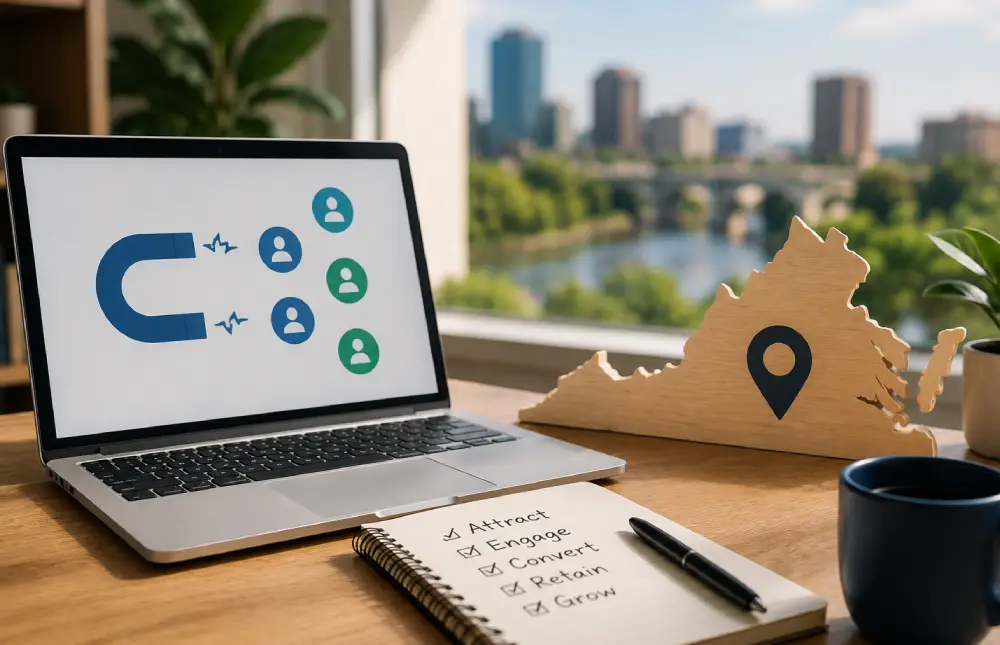
Start With One Question: Where Are Your Next Clients Looking?
Before spending money on advertising, figure out where your ideal customers already look for businesses like yours.
A homeowner looking for emergency plumbing in Richmond might search Google. Someone looking for a wedding photographer may ask friends or browse Instagram. A property manager looking for a commercial cleaning company may rely on referrals and professional networks.
Your marketing should follow that behavior.
| Business Type | Potential Client Sources |
|---|---|
| Plumber or HVAC company | Google Search, Google Maps, referrals |
| Roofing contractor | Google Maps, referrals, real estate partnerships |
| Restaurant | Google Maps, reviews, social media |
| Attorney | Google Search, referrals, professional networks |
| Consultant | LinkedIn, networking, referrals, content |
| Cleaning company | Google, local groups, property managers |
| Landscaping company | Google Maps, neighborhood referrals, partnerships |
| B2B service company | Networking, LinkedIn, referrals, organic search |
This simple exercise can prevent a common mistake: spending your entire marketing budget on a channel your customers barely use.
Build a Local Presence Before Chasing More Traffic
A new business often thinks the answer is more website visitors.
But imagine you get 1,000 visitors and only one person contacts you. The problem isn't necessarily traffic. It could be positioning, trust, targeting, or conversion.
For a local business, your online presence should quickly answer: What do you do? Where do you work? Why should I trust you? How do I contact you?
Your website, Google Business Profile, reviews, social profiles, and other online references should tell a consistent story.
Make your service area obvious
If your business serves Richmond and nearby communities, don't make visitors dig through your website to discover that.
Explain the areas you genuinely serve, but avoid creating dozens of nearly identical pages just because you want to rank for every Virginia city. Location pages work best when they provide useful information about the market, services, customers, or projects associated with that area.
A Richmond contractor, for example, could discuss the types of projects it handles locally, common customer questions, service availability, and genuine examples of completed work.
That's more useful than a page that simply changes “Richmond” to “Henrico” and “Chesterfield.”
Google Can Become Your 24/7 Lead Source
For many Virginia businesses, Google is one of the most valuable places to be visible because people often search when they already have a problem to solve.
Someone searching for “tree removal Richmond VA” is different from someone reading an article about how trees grow. The first person may need a company today.
This is where local search engine optimization becomes particularly useful.
A well-optimized Google Business Profile can help an eligible local business appear in Google Search and Maps, while a strong website can support visibility for service-related and informational searches.
Don't treat Google Maps like a one-time setup
Creating your Google Business Profile is only the beginning.
Keep your business information accurate, use appropriate categories, explain your services, add genuine photographs, maintain accurate hours, and respond naturally to customer reviews. Encourage legitimate customers to leave honest feedback after completing a job, but don't buy reviews or manipulate ratings.
Local search visibility is built from multiple signals working together rather than one secret trick.
Turn Existing Customers Into Your Next Customers
One of the cheapest ways to get more clients is to stop thinking of every customer as a one-time transaction.
A satisfied customer can become a source of:
- Repeat business
- Referrals
- Reviews
- Testimonials
- Case studies
- Social proof
- Professional introductions
Suppose a Richmond landscaping company completes a large backyard project. Instead of simply sending the final invoice, the company could ask whether the customer knows another homeowner who might need similar work, request an honest review, and, where appropriate, create a case study showing the transformation.
One successful project can then contribute to several future marketing assets.
Make referrals easy
Don't tell customers, “Let me know if you know anyone.”
Give them something specific.
For example: “If you know another homeowner in the Richmond area who needs seasonal landscaping, we'd appreciate an introduction.”
Specific requests are easier for people to act on than vague ones.
Build Partnerships With Businesses That Already Have Your Customers
You don't always need to find customers directly.
Sometimes another local business has already built the relationship you want.
Consider a few examples:
- A roofer can connect with real estate agents.
- A junk removal company can connect with estate sale companies.
- A landscaper can build relationships with property managers.
- A wedding photographer can partner with venues and planners.
- A commercial cleaner can connect with office managers and property companies.
The relationship should make sense for both sides. Instead of sending generic sales messages to hundreds of businesses, find a smaller number of complementary companies and look for ways to create genuine value.
Use Local Content to Get Discovered Before the Sales Conversation
Content marketing becomes much more useful when it answers questions your potential customers actually have.
Don't publish articles simply because someone told you that “businesses need blogs.”
Think about the questions people ask before buying.
A Virginia roofing company could publish:
- How much does roof replacement cost in Virginia?
- How to prepare your home before a major storm
- Signs your roof may need repair
- What Virginia homeowners should know about storm damage
The goal isn't to stuff the article with keywords. It's to become useful enough that a potential customer remembers the business when they're ready to hire.
Local content can also support your service pages
Suppose you publish an article about choosing a roofing contractor in Richmond. Within the article, you can naturally direct readers toward your relevant service page.
This creates a useful path:
Helpful information → Service page → Contact → Lead
That is much more valuable than publishing dozens of disconnected articles.
Don't Ignore Offline Marketing
Digital marketing gets most of the attention today, but local businesses can still win customers offline.
Consider:
- Local networking groups
- Community events
- Industry associations
- Sponsorships
- Local business organizations
- Referral partnerships
- Workshops
- Direct relationships with property managers
For a small Virginia business, being known locally can become a competitive advantage that isn't easy for a national competitor to replicate.
The strongest local marketing strategies often combine online visibility with real-world relationships.
Make Your Website Convert the People You Already Attract
Getting someone onto your website is only half the job.
Look at your homepage as if you've never seen the company before. Can you immediately understand what the business does and where it operates? Is there an obvious way to request a quote, call, schedule an appointment, or ask a question?
A local service page should also make the next step obvious.
Instead of forcing someone to hunt through navigation, provide relevant calls to action near important information. Include trust signals such as genuine reviews, project examples, certifications where applicable, and clear contact details.
You don't need aggressive pop-ups everywhere. You need a website that makes the decision to contact you feel easy.
A Simple Example: Getting More Clients for a Richmond Service Business
Imagine you launch a small pressure-washing company serving Richmond.
During the first month, you focus on five things:
- Build a professional website with clear service pages.
- Set up and properly maintain your Google Business Profile.
- Ask genuine customers for reviews after completed jobs.
- Build relationships with property managers and real estate professionals.
- Publish useful content around questions local homeowners actually ask.
Now imagine a potential customer searches for pressure washing. They discover your Google listing, see recent reviews, visit your website, look at examples of your work, and submit a quote request.
At the same time, a property manager you've met refers another customer. You've created two acquisition paths instead of depending entirely on paid advertising.
That's the kind of system a small business can build gradually.
What About Paid Advertising?
Paid advertising can be useful, particularly when you need leads quickly or are testing a new service.
But don't assume you have to choose between advertising and SEO.
A sensible approach can use paid search for immediate visibility while building organic and local search visibility for the longer term.
For example, a new Virginia home-service company could use carefully targeted advertising to generate early enquiries while simultaneously improving its website, Google Business Profile, reviews, and local authority.
The important thing is to track which channel actually produces profitable customers.
Track Clients, Not Vanity Metrics
One of the easiest ways to waste money is to celebrate marketing numbers that don't affect revenue.
Website traffic, impressions, and rankings can be useful diagnostic metrics, but they aren't the final objective.
Track:
| Metric | What It Tells You |
|---|---|
| Qualified calls | Whether people are actively interested |
| Quote requests | Commercial intent |
| Booked appointments | Actual opportunities |
| New customers | Business growth |
| Cost per lead | Marketing efficiency |
| Customer acquisition cost | Overall acquisition economics |
| Revenue by channel | Which marketing activities create value |
If Google generates 30 calls and another channel generates 300 website visits but zero customers, you have a pretty clear signal about where to focus.
When Local SEO Becomes a Growth Engine
Once your business has a strong foundation, local SEO can become one of the most useful long-term acquisition channels.
The objective isn't simply to rank for “SEO Virginia” or another broad phrase. For a local business, valuable searches are often much closer to the customer's actual need: “emergency electrician near me,” “roof repair Richmond,” “commercial cleaning Arlington,” or similar service-and-location searches.
That is why the relationship between service relevance, geographic relevance, Google Maps visibility, website quality, reviews, and local authority matters so much.
For a Richmond business specifically, working with an experienced SEO Service in Richmond can help create a strategy around the customers and searches that matter to that market.
Frequently Asked Questions
What is the fastest way to get clients for a new Virginia business?
There isn't one universal method, but referrals, direct relationships, local networking, targeted advertising, and Google Search or Maps can all produce opportunities relatively quickly depending on the industry. The best starting point is usually the channel where your ideal customers already have strong buying intent.
How can I get local customers without spending a lot on advertising?
Start with your existing network, referral relationships, local partnerships, Google Business Profile, customer reviews, useful content, and community connections. These activities can take time, but they can build assets that continue producing opportunities rather than disappearing when an ad budget stops.
How important is Google Maps for getting local clients?
For many service-area and location-dependent businesses, it can be extremely important. Customers frequently use Maps when actively looking for nearby providers, making local visibility particularly valuable for businesses such as contractors, home services, restaurants, and professional practices.
How can I get more customers from Google?
Make sure your Google Business Profile and website clearly communicate what you offer and where you operate, earn genuine customer reviews, publish useful content, maintain consistent business information, and build legitimate local authority. Avoid shortcuts such as fake reviews, keyword stuffing, or artificial business locations.
Should a Virginia business target the whole state?
Only if the business genuinely serves a large portion of Virginia. A small local company will usually get more value from dominating its actual service area before expanding geographically. A business with statewide operations can develop broader location and service strategies as its capacity supports them.
How long does it take to get clients through SEO?
Some improvements can produce movement relatively quickly, but meaningful organic and local visibility usually develops over time. Competition, website authority, existing reputation, service area, content quality, and the strength of your local presence all affect the timeline.
The Goal Isn't More Leads. It's Better Clients.
Getting clients for a Virginia business isn't about finding one magical marketing channel.
It's about creating several dependable paths that lead the right customers to you.
Google can bring someone actively searching for your service. A past customer can introduce you to a neighbour. A local partnership can produce recurring referrals. A helpful article can answer a question months before someone is ready to buy. A strong website can turn that attention into a quote request.
Start with one or two channels you can execute well, measure which ones drive actual customers, and improve from there. As your business grows, your marketing system can grow with it.
For businesses competing specifically in Richmond, local search can be an especially valuable part of that system. A stronger Google presence can help you get discovered by people who are already looking for the services you provide, rather than asking you to convince completely cold audiences that they need you.